
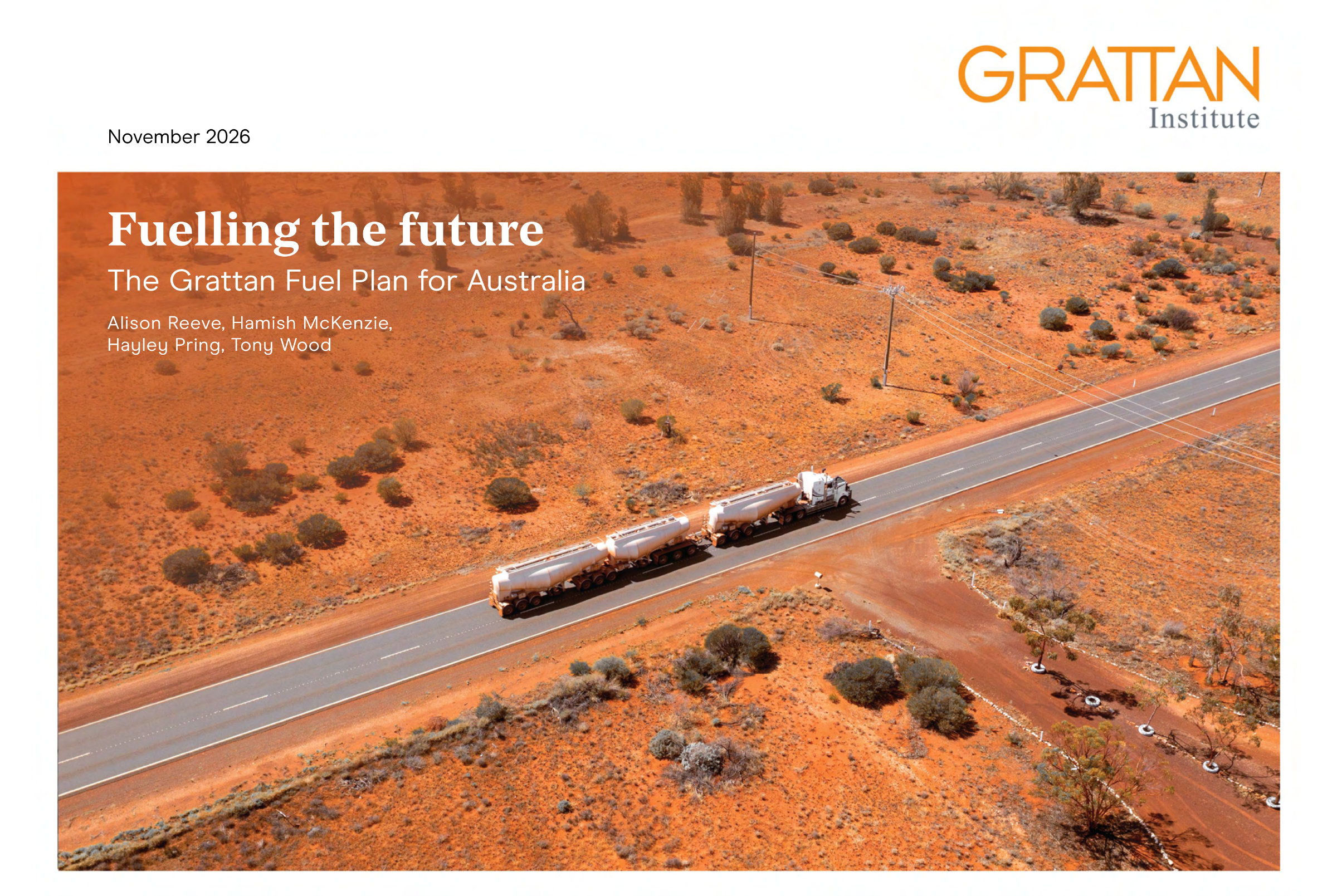
Australia has a fuel security problem. Each year, Australia uses 60 billion litres of liquid fuels – and 97 per cent of it is imported.
Australians have seen the cost of this dependency. The Iran War has cost Australians $18 billion and the federal government at least $3 billion, and has driven up inflation. In a more unstable future, disruptions like this will be more frequent.
Insulating Australia from future fuel shocks requires a three-part strategy: reducing reliance, buffering impacts, and spending prudently in a crisis. In more benign times, successive federal governments mostly focused on buffers and occasional crisis spending. But Australia has no strategy to reduce reliance on imported fuels. In an era of disruption, this is no longer tenable.
The Grattan Fuel Plan for Australia is a proposal to change course.
Their centrepiece recommendation is that the government should set a sovereign fuel target for each of the largest fuel-using sectors. Road transport, mining, and aviation should use at least 50 per cent locally made fuels by 2050. To hit these targets, three moves are needed.
First, the government should set an electric truck sales target to deploy 670,000 trucks by 2050 and cut diesel use by 5 billion litres. To fuel this fleet, the government should invest $1.1 billion in a network of chargers, and $2.4 billion in vouchers to buy electric trucks.
Second, the government should cap diesel fuel tax credits at $35 million per corporate group per year. By 2050, this would save the government $76 billion and cut annual diesel use in mining by 3.5 billion litres.
Third, for aviation, the government should set a mandatory target for clean fuels and put $6 billion towards the first set of clean refineries. By 2050, this would deliver 9.8 billion litres of clean jet fuel a year.
Cars, utes, and vans are already on a trajectory for a high sovereign fuel share as Australians choose to go electric. The government should lock that in by tightening vehicle emissions standards.
Building more oil refineries will do nothing to increase Australia’s sovereign fuel supply. Australia is running out of crude oil, and a new refinery processing imported crude oil exposes Australia to the same set of risks as importing refined products.
Governments should not put public money into new oil refineries. However, Australia’s two remaining oil refineries contribute materially to supply of sovereign fuel today at relatively low cost. The federal government should extend its financial support, to keep the refineries open until they run out of Australian crude, or when local sources of clean fuel can replace them.
Taken together, these measures would reduce demand for imported fuel by 18 billion litres in 2050. They would also reduce emissions from fuel consumption by 58 per cent compared to remaining reliant on imported liquid fuels, helping Australia to hit its climate targets.
Gratton’s proposal saves more than it spends, delivering net $55 billion to the federal budget by 2050. The typical household would spend $3,344 less on fuel in 2050 under our Plan. Motorists in general would save $3.6 billion in avoided fuel storage costs. And if global oil prices spiked in 2050 as much as they did during the Iran War, Australians would be $41 billion better off under our Plan.
The Iran War has given the government an opportunity to permanently insulate households and businesses from geopolitical shocks, to lower fuel costs, and to increase the resilience of the economy. The government should seize it.
Download the technical supplement
Download methodological supplement
Report by Alison Reeve, Hamish McKenzie, Hayley Pring, Tony Wood

Leave a Reply